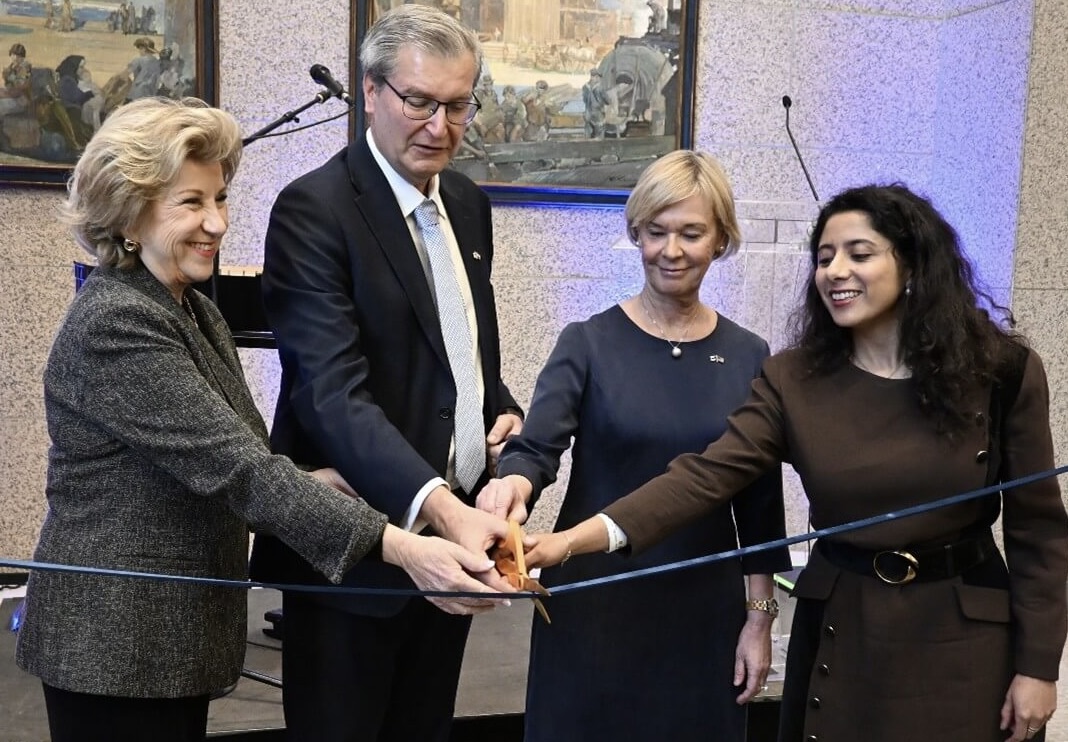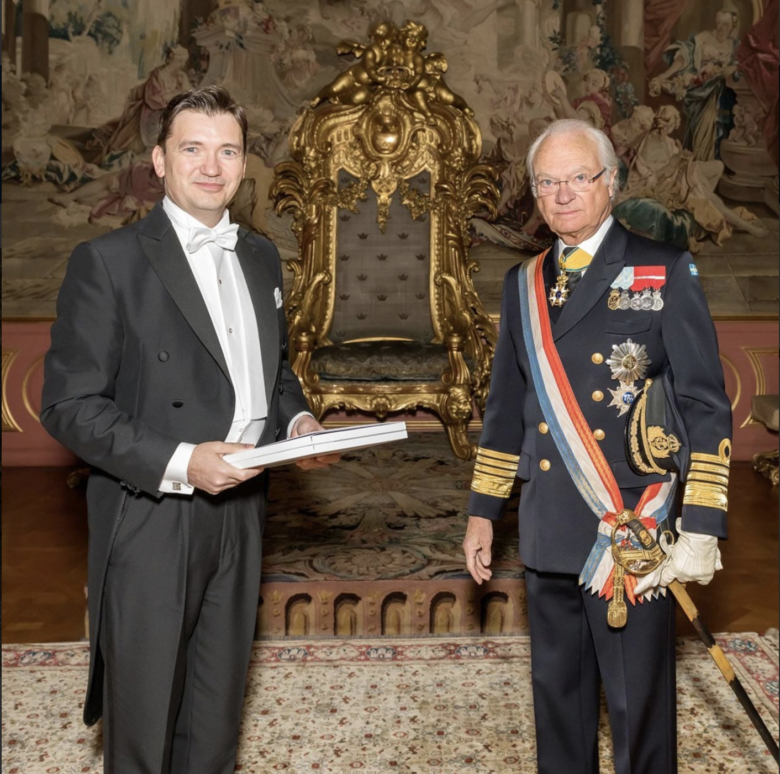
Ambassador Sinisa Grgic thinks artificial intelligence will do for diplomacy what the taming of fire did for early humans—and he says diplomats who refuse to learn how to use it are choosing extinction. When we spoke over Google Meet, he was in Stockholm juggling the Finnish ambassador’s courtesy call, a backlog of dean‑of‑the‑corps obligations, and what he describes as his “third career” as an author and data‑driven reformer.
The dean who digitized his embassy
When the pandemic pushed Stockholm’s once intensely in‑person diplomatic corps onto Zoom, Sinisa Grgic discovered just how analog his profession still was. As Croatia’s ambassador to Sweden and Latvia—and, by virtue of seniority, dean of the diplomatic corps in Stockholm—he suddenly found himself trying to convene weekly heads‑of‑mission meetings online while colleagues fretted over security protocols and struggled with basic digital tools.
“I was surprised to see how difficult it was among colleagues to get connected,” Grgic recalls, noting that many were older, wary of new technology and deeply attached to the centuries‑old rituals of one‑on‑one meetings and corridor chats. That experience, combined with a favorite Stockholm monument to Axel Oxenstierna—the royal adviser who warned his son, “you’d be surprised with how little knowledge this world is governed”—crystallized a thesis Grgic now pursues full‑time: diplomats, like everyone else, are governing on thin informational ice.
“We rely on the same news as ordinary people,” he says, pointing to a media ecosystem he sees as a “big mess” of competing lobbies and social‑media narratives. The result, in his view, is that embassies, foreign ministries and ultimately leaders are too often operating on prejudice and partial information rather than facts. AI, he decided, could change that.
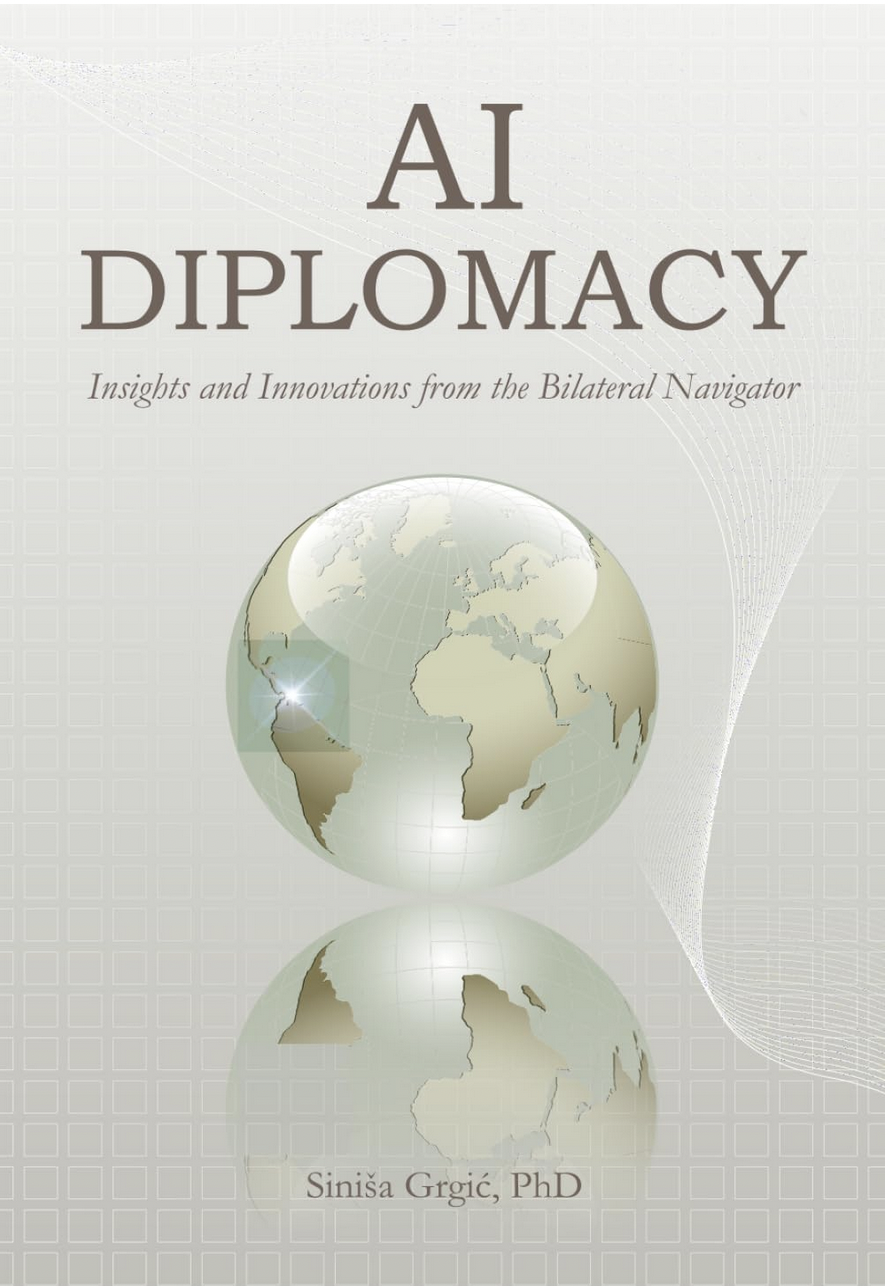
In his new book, AI Diplomacy, Grgic makes an unapologetically sweeping claim: large‑scale AI is “maybe the biggest discovery of all human history,” comparable only to early humans learning to manipulate fire two million years ago. “We are descendants of those who knew how to manipulate fire, not those who didn’t,” Grgic says. “Survivors will be those who know how to deal with AI, not those who fear it.”
The analogy is pointed at his own peers. While journalists, he notes, have spent years focused on the risks AI poses to their craft, diplomats often lag even in basic digital literacy. Yet foreign ministries are beginning to outsource core analytical work—monitoring, synthesis, scenario‑building—to opaque models and external platforms built in the United States and China.
Grgic is no naïf about the technology’s problems. He worries about AI becoming a “golden calf of modern humanity,” a quasi‑religious object of worship that leaders invest with more authority than it deserves simply because it feels omniscient.
“Many people will see it as a god,” he warns. “It’s just a question of time when they will start worshipping it.” Still, he argues, trusting AI may already be “better than trusting horoscopes,” which have been empirically debunked even as politicians and publics continue to rely on them.
What he finds most dangerous is not AI’s current fallibility but its accelerating competence. Citing recent leaps in commercial large language models, he notes that the free tools many diplomats experiment with are “totally wrong” as a benchmark for the state of the art. Paid systems, he insists, already perform like “Nobel prize winners” across domains, and newer models capable of improving themselves mark a shift “out of our control” that will still overwhelmingly benefit societies that learn to use them.
Ghosts in the embassy machines
To prove his point, Grgic turned his own small mission into a test case. With just five staff in Stockholm, he repurposed old, air‑gapped laptops as hosts for what he calls AI “agents”—”ghosts directing the computer,” as he jokes to visitors. Those agents ingest local media, analyze news flows and generate the kind of press clippings and syntheses that once required a dedicated human officer or outside contractor.
The effect, he argues, is to blur traditional lines between large and small posts. “As a small embassy, we can be comparable to a larger embassy,” he says. Where big missions could once afford bespoke research on trade, investment or migration links, a handful of agents now offer a low‑cost way for a five‑person team to match that analytical muscle.
That logic scales. Grgic believes the first profession hit by AI was programming—”50% of all coding at the moment is done by AI,” he claims—and that law and primary medicine will follow, with diplomacy not far behind. He envisions ubiquitous AI‑enabled booths that can run basic diagnostics in 15 minutes, and a tax base that shifts from labor to capital because “you can’t tax work anymore when robots and agents produce more wealth than any human.”
For foreign ministries, the near‑term impact is more prosaic but no less profound: fewer support roles, more automation of monitoring and reporting, and a premium on the rare functions machines cannot easily perform.
Mapping the world’s “dark matter”
Grgic’s most ambitious answer to that reality is the Bilateral Navigator, a sprawling AI‑driven research and publishing project that attempts to map every country‑to‑country relationship on earth. Starting from the 193 UN member states, he multiplies each by the 192 others, divides by two to avoid double‑counting (Croatia–United States is the same as United States–Croatia), and arrives at 18,528 unique bilateral combinations.
For each of those pairs, the project has produced a hardcover coffee‑table book—18,528 volumes in all—assembling data on trade, investment, migration, minorities, historical ties and other connective tissue between the two states. “This is a bigger number than all the books ever published by any Croat or any smaller nation in past centuries,” Grgic says.
The point is not bibliophilic excess. Grgic’s research suggests that 96% of those bilateral relationships have never been the subject of a single dedicated book or study. Exceptions cluster among great powers and conflict dyads—US–UK, India–UK, India–Pakistan, Israel–Palestine—while the vast majority of combinations among small and medium‑sized countries exist in what he calls informational darkness.
“Predominantly the countries are small or medium size, and those SMCs create a really big number of combinations,” he notes. “That’s where you don’t have literally anything, and filling that gap is what I smelled was the right thing to do.”
Each volume, compiled with AI assistance from “hundreds of different sources” across institutions worldwide, tries to offer a neutral, verifiable baseline—”we give data and then people can choose,” he says, stressing that he refuses to interpret the numbers for readers. Trust, in his view, comes from transparency and source diversity, not authorial voice.
A think tank made of contributors
If the books are the most visible artefact, Grgic insists the Bilateral Navigator is less a publishing house than an evolving platform and think tank. As of this winter, he says, roughly 1,000 embassies, consulates and honorary consuls worldwide have copies of the relevant volumes on their desks. The prime minister of Pakistan recently used the Pakistan–Austria book, co‑authored with Islamabad’s ambassador in Vienna, as a gift and “door opener” in a meeting with the Austrian chancellor.
Behind the hardcovers is a growing network of human “bridge builders”—the business people, diaspora organizers, local officials and subject‑matter experts whose contributions feed into the Navigator’s data lake. By the end of the year, Grgic expects some 300,000 such contributors from around the world, a scale that leads him to describe the project as “the largest think tank on bilateral relations by far.”
The model turns traditional authorship on its head. In the old paradigm, he says, a single writer like J.K. Rowling sits at the center, broadcasting to millions of anonymous readers who cannot talk back. The Navigator inverts that. “We use contributions from millions of people or even billions and create one book for you personally or for very few,” he explains.
AI makes that inversion economically viable. Print‑on‑demand services like Amazon’s, Lulu and IngramSpark—along with a patchwork of national printers—allow the project to generate bespoke, small‑run volumes at roughly “the price of a book,” rather than the tens of thousands of dollars a private consultancy might charge for a single bilateral report.
Grgic bristles at the idea that “books are dead.” In his reading, AI has made them “never more alive,” precisely because it allows for individually tailored, high‑value physical objects that serve as both analytical tools and diplomatic tokens. “It’s something that you leave and you celebrate together with the counterparty,” he says. “You celebrate a relationship rather than an individual country, which is much more appreciated.”
Democracy, data and the taco buffet
But despite all the advances, authentic human interaction remains the cornerstone of diplomacy.
Asked how diplomats should prepare for an AI‑saturated future, Grgic had a surprising answer. “What you’re doing now…your smile,” he tells me. “When you smile, this is something AI would never be able to take away from us.”
I find this oddly reassuring. After all, a cornerstone of Diplomatica Global Media’s community has been informal, off-the-record gatherings, usual over a taco buffet, for nearly a decade.
But Grgic doesn’t see the end of taco nights anytime soon. In fact, he says they might be more of a diplomatic requirement than ever.
The career “salvation,” as he sees it, lies in doubling down on the uniquely human capacities—empathy, humor, trust‑building, the ability to walk with a counterpart in the woods or share a game or a meal—that will only grow more valuable as machines absorb more technical tasks. He imagines diplomats with “much more free time” using it to build genuine bridges, getting “more independent from mobile phones and from screens in general.”
That vision comes with a warning: the emotional and relational labor required to sustain diplomacy may fall unevenly. Younger officials shaped by the pandemic may become highly adept at AI while remaining uncomfortable with the face‑to‑face conversations on which negotiations still depend.
Grgic expects a bifurcation: a cohort of highly influential diplomats who can wield technology to “achieve much bigger and stronger results” globally, and another group whose gift for empathy and local relationship‑building delivers impact closer to home. The most powerful will be those who manage to combine both.
Fighting the attention economy
If AI is the new fire, Grgic argues, the information ecosystem around it still runs on older, destructive fuel: outrage and fear. He is particularly exercised about what he calls “unfair business practices,” in which media outlets and platforms monetize human tragedy through clickbait and adjacent advertising.
In his view, European and US regulators should extend existing unfair‑practices rules to forbid making money from disaster content—”you can still publish your news that some earthquake hit a country but you can’t sell something on the same page.” That single change, he believes, would “cut the neck of this beast” by starving fear‑driven engagement of revenue and nudging media toward more empathy‑driven coverage.
Underpinning both his AI optimism and his media critique is an appeal for intellectual humility and curiosity. He laments how rarely politicians or commentators now say, “I didn’t think of that, that’s actually a very good idea,” especially when speaking to someone from another party. For him, a healthier information order—human or machine‑mediated—starts with the willingness to be wrong in public.
“I would like people to think by their own head, not to be told what they should think,” he says. “We should not be manipulated. In order not to get manipulated, you have to be open for every discussion.”
Three careers, one bet
Grgic’s conviction that diplomacy needs AI as much as AI needs human diplomacy is rooted in an unusually eclectic CV. By training he is an engineer and data scientist; by experience, he has been a successful NGO leader, a businessman and now, in what he calls his “third career,” an ambassador. He also completed Croatia’s diplomatic academy 25 years ago, fulfilling a long‑held ambition to enter foreign service.
He likes to quote Ivo Andric, the Yugoslav Nobel laureate, who once observed that no profession attracts as many people “from nowhere” as diplomacy—people without formal preparation who bring their own identities and prior lives into the job. For Grgic, that heterodoxy is a strength, provided diplomats are willing to keep learning.
“We will reach levels of development and enrichment we couldn’t even think possible,” he says of the AI era. Whether smaller states and their emissaries share in that abundance, or are left governed by someone else’s algorithms and prejudices, will depend on how quickly they learn to wield the new fire—and how fiercely they defend the human warmth that still makes diplomacy work.