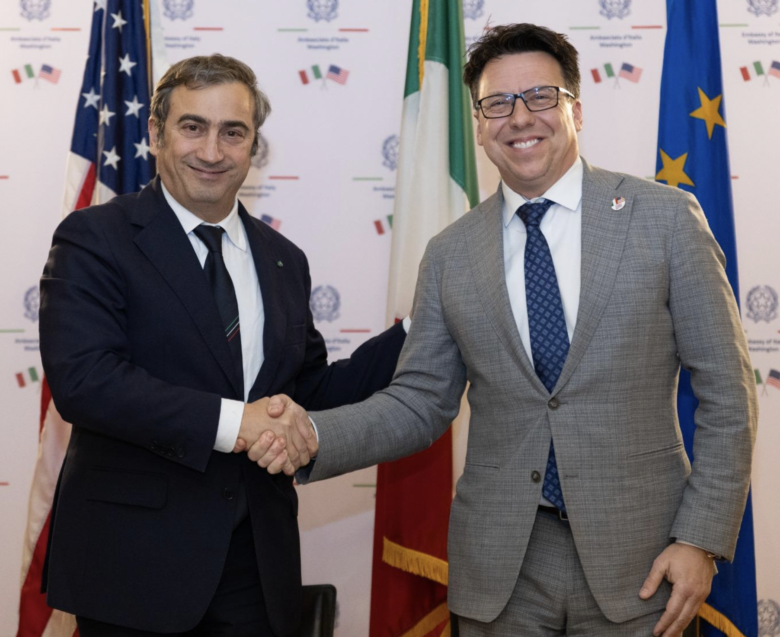
Washington, D.C., January 21, 2026 — At the Italian ambassador’s residence, the historic Villa Firenze, diplomats, law-enforcement officials, and cultural heritage leaders gathered for “Custodians of Culture,” marking 25 years of the U.S.–Italy Cultural Property Agreement with a repatriation ceremony and policy dialogue. Framed by the setting’s old-world grandeur, the evening underscored how a technical bilateral accord has evolved into a flagship instrument of cultural diplomacy and cross-border law enforcement cooperation.
Signed in 2000 and renewed four times, most recently through a new Memorandum of Understanding concluded in Rome on December 5, 2025, the agreement between Italy and the United States is now the longest-standing cultural property compact in continental Europe, and a reference point for efforts to curb the illicit trade in antiquities. Officials highlighted that over a quarter century the framework has enabled the recovery and return of more than 5,000 artifacts to Italy, while also strengthening legal trade and cultural exchange.
Opening the program, Ambassador of Italy to the United States H.E. Marco Peronaci stressed that the accord is “not only about regulation—it is about values,” describing cultural heritage as a shared legacy rather than a commodity and framing the fight against looting and trafficking as a defense of collective memory. The event followed the December signing in Rome by Italian Minister of Culture Alessandro Giuli and U.S. Under Secretary of State for Public Diplomacy Sarah B. Rogers, which renewed import restrictions on Italian cultural property and reaffirmed the political will behind the partnership.
From the U.S. side, senior officials from the Department of State’s Bureau of Educational and Cultural Affairs, Immigration and Customs Enforcement, and the FBI underlined the operational dimension of that commitment. Protecting cultural heritage, one senior State Department official noted, is about safeguarding identity and the foundations of civilization for future generations, while ICE and FBI representatives pointed to the agreement’s role in enabling joint investigations, seizures, and returns.
Italy’s specialized capacity was represented by Brigadier General Antonio Petti, Commander of the Carabinieri Unit for the Protection of Cultural Heritage, widely regarded as a global model for dedicated cultural property policing. His intervention spotlighted how sustained cooperation with U.S. counterparts has shifted incentives for traffickers, tightened borders, and elevated cultural heritage crimes on the international security agenda.
A compact but symbolically charged exhibition of confiscated artworks, installed within Villa Firenze, served as a visual through line for the evening. The pieces, accompanied by a signing ceremony for restitution certificates, illustrated the life cycle of illicit objects—from clandestine excavation and illicit export to seizure and return—and how coordination between prosecutors, investigators, and diplomats can bring that cycle to an end.
The discussion then moved from enforcement to policy and practice through a panel featuring Deborah Lehr, Founder of the Antiquities Coalition and Interim CEO of Meridian International Center; Chase F. Robinson, Director of the Smithsonian’s National Museum of Asian Art; and art and museum lawyer Channah Norman. Moderated in an informal, conversational format, the trio explored emerging strategies to disrupt the illicit antiquities market, including enhanced due diligence, provenance research, and the deployment of new technologies to increase transparency and traceability across global art supply chains.
Panelists examined how governments, museums, law enforcement, and the private sector can better align incentives—through regulation, soft-law standards, and voluntary commitments—to reduce demand for trafficked objects. They also discussed how digital tools, from databases to artificial intelligence, are reshaping provenance work and supporting both investigative and compliance efforts, while underscoring the continued need for specialist expertise and international information-sharing.
Beyond its immediate focus on cultural heritage, the evening doubled as the launch of “Villa Firenze Talks,” a new series convened by Ambassador Peronaci to bring together policymakers, experts, academics, and industry leaders around a broad agenda of transatlantic challenges. Future installments are expected to range from geopolitics and security to innovation, emerging technologies, and the cultural sector, positioning the residence as a platform for sustained strategic dialogue.
As guests returned to the exhibition at the close of the program, the atmosphere was more workshop than ceremony: conversations threaded practical questions of enforcement and ethics through a shared recognition that cultural property policy now sits at the intersection of diplomacy, security, and global markets. A quarter century after the U.S.–Italy agreement first entered into force, Villa Firenze offered a snapshot of a partnership that has moved beyond simply recovering objects to shaping the rules of the game for cultural heritage protection worldwide.