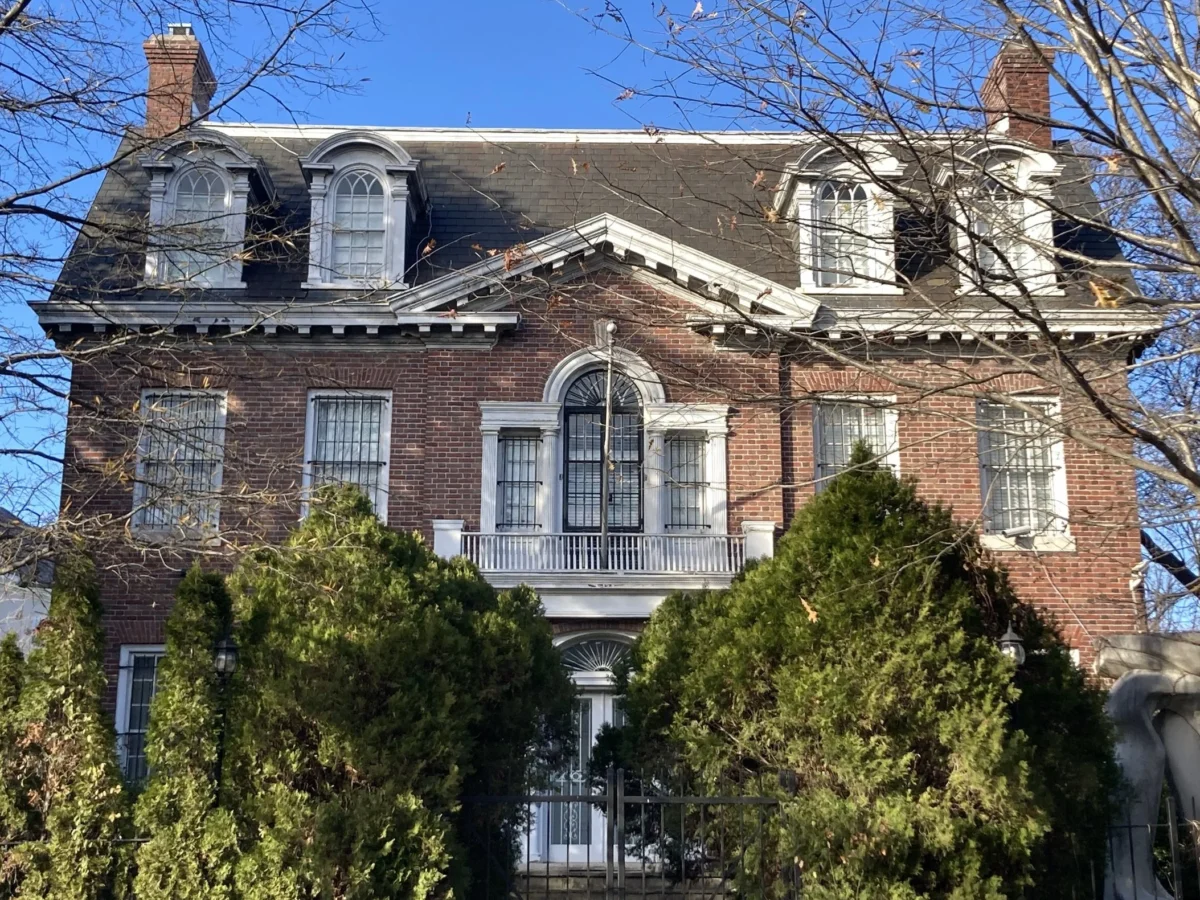
At the corner of 18th and P Street in Dupont Circle, the Boardman House commands curiosity; its Beaux-Arts architecture with distinctive orange Roman-brick façades, soaring windows, and Syrian archway draws spontaneous stops from passing tour buses. Visitors pause, undeterred by the snarling lion at the gate, and drawn in by the building itself, adorned with a mosaic marking its 1894 opening and glowing in the autumnal twilight. Some may know it as the former home of Mabel Boardman, the philanthropist whose legacy influenced Washington society and American humanitarian work. But they likely don’t know it was the site of a quiet revolution, and one of most consequential and little-known coups in American philanthropy.

When the American Red Cross received its federal charter in 1900, socialite Boardman’s name was added to the board of incorporators without her knowledge. In a few short years, she leveraged her social capital and political connections to transform a small, insular organization into a national institution with nearly thirty million members.
Yet her ascent began in conflict—by leading a movement to overthrow Clara Barton, the organization’s fierce founder whose personal control had long stifled modernization. A Senate inquiry followed. When President Theodore Roosevelt withdrew federal patronage, Barton resigned in 1904, and Boardman assumed leadership.
Within a few years, she was being fêted on the international stage; earning decorations from the Italian government, the King of Sweden, the French government, and recognitions from the governments of Belgium, Chile, Japan, Portugal and Serbia.
Navigating a Washington skeptical of female authority, Boardman made President Theodore Roosevelt and William Howard Taft the official faces of the organization, while she quietly retained executive control behind the scenes, from her mansion in Dupont.

Boardman’s house was more than a residence; it was a statement. When Hornblower & Marshall—Washington’s foremost Beaux-Arts architects—designed the building in 1893, they drew inspiration from H. H. Richardson’s nearby houses for Henry Adams and John Hay on Lafayette Square, which historian Gil Klein regards as central to shaping the city’s architectural character. (See: Trouble in Lafayette Square: Assassination, Protest & Murder at the White House.)
Boardman House not only served as the incubator for the modern American Red Cross, but as the founding location and original headquarters of the private women’s organization, the Sulgrave Club (named after the English hereditary seat of George Washington’s family).
After successfully leading fundraising for the current Red Cross headquarters on 17th Street (dubbed the Marble Palace), Boardman led the charge to raise the funds to purchase the nearby Wadsworth House, itself a former local chapter of the Red Cross, as the Sulgrave Club’s new headquarters. Its members still gather there today (with arguably the best afternoon teas in Washington, a vestige of Boardman’s legacy.)
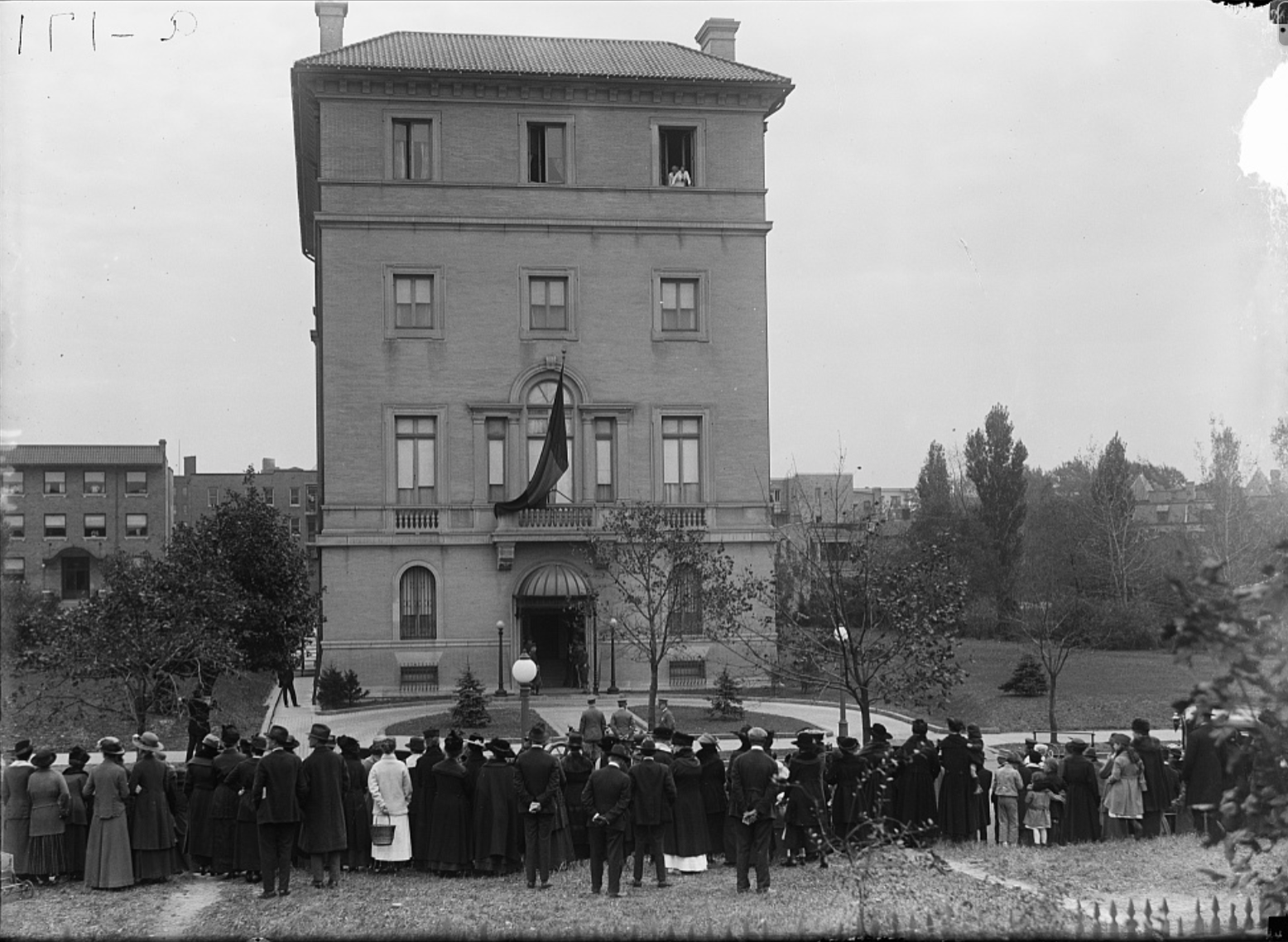
In 1946, at the age of 85 and after more than 40 years of unpaid service to the American Red Cross, Mabel Boardman died in her bed at 1801 P Street. Like the homes of Alice Pike Barney who died the decade before and Evalyn Walsh McLean, who died wearing the Hope Diamond a short time after, the home of this trail-blazing woman would become an embassy.

Iraq and the United States established diplomatic ties in 1888, when Baghdad was part of the Ottoman Empire. The first American consul, John Henry Haynes—later known as the “father of American archaeological photography”—initially carried out his duties from Constantinople before presenting his credentials in Baghdad on January 8, 1889. When the United States recognized Iraq as an independent state in 1930, the two countries established legations, which were upgraded to embassies in 1946.
In 1962, the government of Iraq purchased the Boardman House for $394,000 to replace its chancery on Wyoming Avenue.
After the Arab-Israeli War in 1967, Iraq broke off diplomatic relations with the United States, forcing both countries to shutter their embassies. In Baghdad, Washington maintained only a limited presence: a U.S. Interests Section housed inside the Belgian Embassy, opened in 1972. By 1980, the small office bustled with more diplomats than many full embassies, despite the absence of formal ties. In Washington, Iraq’s former embassy was reduced to a Special Interests Section that operated under the Embassy of India, handling routine consular work without official diplomatic status.
Relations briefly normalized in 1984, and both capitals restored full embassies. But after Iraq’s 1990 invasion of Kuwait, ties collapsed again. In Baghdad, Poland took charge of the U.S. Interests Section, while in Washington, the Iraqi Interests Section continued under the Algerian flag, serving the Iraqi American community and managing travel and visa requests. Iraqi diplomats, confined by the State Department to a 25-mile radius of the embassy, operated in this limited capacity until the U.S.-led invasion of 2003.
In 2004, just over a year after the U.S. invasion, Washington and Baghdad formally restored full diplomatic relations — a moment marked by a symbolic White House meeting, the raising of Iraq’s flag, and the quiet replacement of the embassy’s brass plate. It was a small but significant gesture, signaling the start of a new chapter in a relationship long defined by conflict and mistrust.


Two decades after the invasion that upended the Middle East, U.S.–Iraq relations have settled into a quieter, more pragmatic phase—one defined less by occupation or ideology and more by negotiation and necessity. The sweeping ambitions that once guided American policy in Baghdad have given way to incremental progress: rebuilding infrastructure, stabilizing energy production, reforming financial systems, and balancing the ever-present influence of Iran.
As the Pew Research Center reminded Americans on the war’s twentieth anniversary, the conflict began under the weight of fear and false assumptions, shaping a generation’s distrust of intervention. Yet in the years since, Iraq has reemerged as a partner determined to define its own future. Prime Minister Mohammed Shia al-Sudani’s 2024 visit to Washington—the largest Iraqi delegation in decades—marked a turning point: a signal that Iraq no longer seeks guardianship but cooperation. For Washington, it was a reminder that influence now comes not through force, but through persistence, partnership, and respect for Iraq’s sovereignty.
Twenty years on, the U.S.–Iraq relationship endures—no longer a story of war and withdrawal, but of two nations still learning how to live with their shared past and, cautiously, to build a new one.

The Boardman House has outlasted its occupants’ ambitions. From Mabel Boardman’s campaign to modernize American charity to Iraq’s long, uneven engagement with the United States, its rooms have carried the weight of reinvention. When the embassy reopened in 2004, the building underwent a careful restoration, and another renovation now looms on the horizon. Yet both Mabel’s touch and Iraq’s presence remain visible throughout: in the grand ballroom where she once convened meetings, now centered by a handmade mosaic above the fireplace, and in the stained-glass windows she commissioned more than a century ago. Listed on the National Register of Historic Places, the house stands as it always has—quietly reflecting the history still unfolding within its walls.

Additional research contributed by Shannon Raymond.