On February 25, Diplomatica Global Media hosted a screening of The Architects of Hope: The First Steps in Rebuilding Ukraine, an award-winning documentary directed by Paul Thomas, as part of a global film festival marking four years of Ukrainian resistance. The film follows Ukrainian architects working to reimagine cities devastated by Russia’s full-scale invasion, centering local expertise as essential to rebuilding efforts and framing reconstruction not as restoration, but as reinvention.
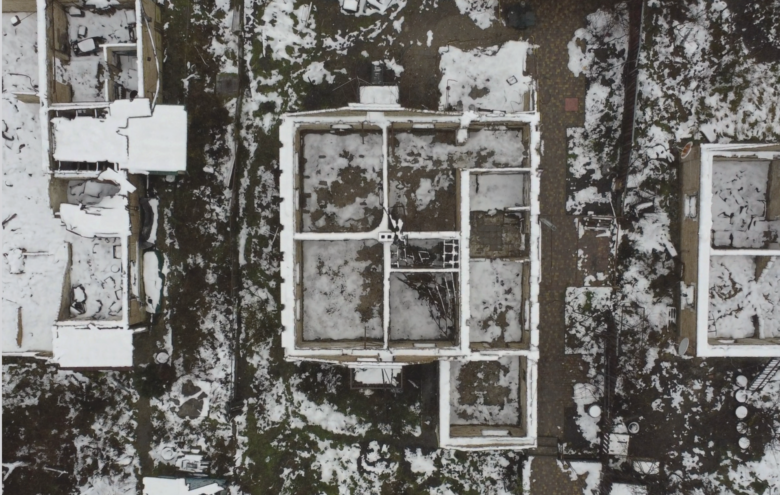
Immediately following the screening, Dr. Suzanne Morse Moomaw, chair of the University of Virginia School of Architecture, spoke of her recent work through the U.S. State Department’s Diplomacy Lab program. In that project, she led a multidisciplinary student studio focused on Izium, an eastern Ukrainian city where much of the built environment was destroyed during Russia’s 2022 assault—work that, while developed in the U.S., was designed to complement and support Ukrainian-led planning efforts on the ground.
Working almost entirely remotely, the team relied on fragmented inputs—video footage, partial geospatial data, and historical maps—to construct a comprehensive recovery proposal. Over the course of three months, students developed a city-scale framework addressing energy systems, housing, water infrastructure, public space, and economic recovery. Their approach began from a simple premise: when as much as 80 percent of a city is gone, rebuilding based on old blueprints simply isn’t practical.
Instead, the student envisioned a bolder plan for the city’s future. Their proposals emphasized decentralized microgrids to harden energy supply against future attacks, resilient water systems, and networks of green public space designed not only for environmental performance but for psychological recovery. Parks and corridors were conceived as biophilic infrastructure—spaces that could help residents process trauma while reestablishing a sense of continuity and place.
Student proposals were presented in Washington to Ukrainian Ambassador Oksana Markarova and U.S. officials, and have since circulated within embassies and State Department forums as tangible models of “green recovery.” In this context, architecture becomes more than design—it becomes a policy instrument, signaling long-term commitments to resilience, sustainability, and Ukraine’s postwar future.
Yet both the film and the discussion made clear that reconstruction is not purely technical. Questions of memory and ethics surfaced repeatedly. One student team grappled with whether to preserve or demolish a kindergarten used as a makeshift detention site during the occupation. Another addressed a forest believed to contain mass graves, ultimately proposing an on-site memorial rather than displacement. These decisions underscored a central tension: rebuilding physical structures cannot erase what communities remember—and that those most affected must have a decisive voice in shaping what comes next.
That awareness extended to process. A core principle of the Izium project was community agency—ensuring that residents and Ukrainian practitioners shape what is rebuilt and how it evolves over time. Students translated their final proposals into Ukrainian before sharing them with officials, an effort to keep the work accessible to those most directly affected.
The discussion also highlighted the economic and political dimensions of reconstruction. Moomaw’s team incorporated “strategic demolition,” designing systems to deconstruct damaged buildings and reuse materials locally. This approach not only reduces environmental impact but creates jobs and helps anchor recovery within the community. As in past post-conflict settings, the question of who controls reconstruction funds—and who benefits from them—remains central.
Hosted on Kinema, a platform supporting independent filmmakers, the event reflected a broader shift in how Ukraine’s recovery is being framed. What emerges from both the documentary and the Izium studio is a model of reconstruction that is forward-looking rather than restorative—one that integrates climate resilience, local participation, and international cooperation.
In that sense, the work coming out of Izium is not just a student exercise or a speculative plan. It is a preview of how 21st-century diplomacy is evolving—where design, policy, and on-the-ground realities intersect, and where rebuilding a city becomes inseparable from rethinking how it should function in the first place.
This screening and discussion was part of Diplomatica Global Media’s ongoing film screening and discussion series. Subscribe to receive alerts on upcoming events.